
Listening Beyond Light
Sometimes the most important discoveries begin with a simple question: what if we could detect what we cannot see?
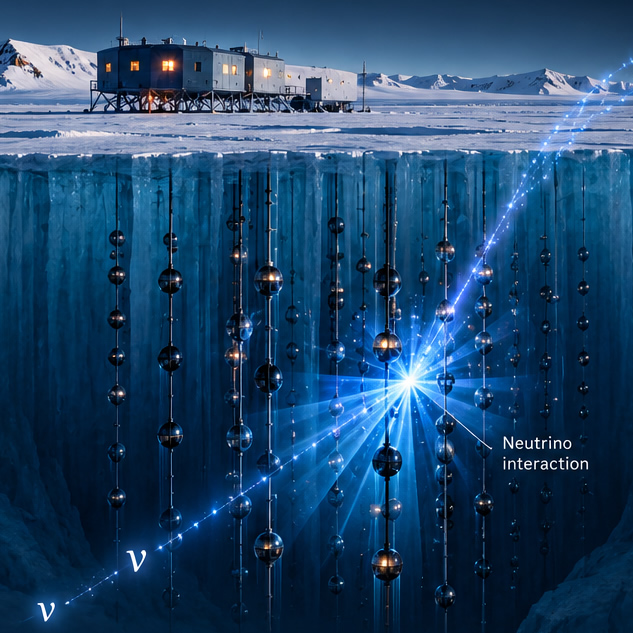
On 6 October 2026, Francis Halzen was awarded the Nobel Prize in Physics for his decisive contributions to the IceCube Neutrino Observatory and the discovery of high-energy neutrinos of astrophysical origin. His remarkable idea was to turn a cubic kilometre of Antarctic ice into a detector, using thousands of light sensors buried deep beneath the South Pole to capture the extraordinarily rare interactions of neutrinos.
Neutrinos pass through matter almost unnoticed. Yet when they are finally detected, they can carry information from some of the most violent events in the Universe — information that conventional astronomical observations cannot provide in the same way.
This is a powerful reminder of something that lies at the heart of science, and very much at the heart of radio science: the Universe does not have to be visible to be observable.
Whether we listen to electromagnetic waves, detect faint signals from space, or capture an almost imperceptible particle interaction deep beneath the ice, scientific progress often begins by finding new ways to sense what was previously beyond our reach.
Francis Halzen's Nobel Prize celebrates not only a remarkable scientific discovery, but also the audacity to build an instrument around an idea that once seemed almost impossible.
Sometimes, to see further, we simply have to learn how to listen differently.
- Mission Statement
- URSI Keydates
- History of URSI
- Statutes of URSI
- Structure
- General Assemblies